


 Cart
Cart
 sales@molnova.com


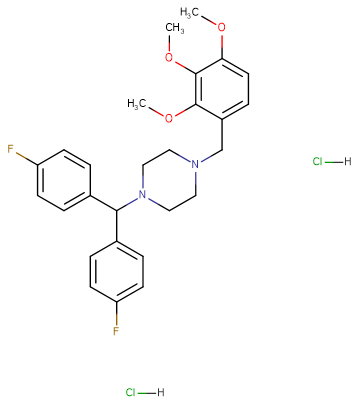
Lomerizine hydrochloride
CAS No. 101477-54-7
Lomerizine hydrochloride( B-2796 | Lomerizine dihydrochloride | Lomerizine HCl )
Catalog No. M10080 CAS No. 101477-54-7
Lomerizine dihydrochloride is a relatively new L- and T-type calcium channel blocker used in the treatment of migraine.
Purity : >98% (HPLC)
 COA
Datasheet
HNMR
HPLC
MSDS
Handing Instructions
COA
Datasheet
HNMR
HPLC
MSDS
Handing Instructions
| Size | Price / USD | Stock | Quantity |
| 25MG | 36 | In Stock |


|
| 50MG | 50 | In Stock |
|
| 100MG | 72 | In Stock |
|
| 200MG | 105 | In Stock |
|
| 500MG | Get Quote | In Stock |
|
| 1G | Get Quote | In Stock |
|
Biological Information
-
Product NameLomerizine hydrochloride
-
NoteResearch use only, not for human use.
-
Brief DescriptionLomerizine dihydrochloride is a relatively new L- and T-type calcium channel blocker used in the treatment of migraine.
-
DescriptionLomerizine dihydrochloride is a relatively new L- and T-type calcium channel blocker used in the treatment of migraine.(In Vitro):Lomerizine is an antagonist of L- and T-type voltagegated calcium channels and transient receptor potential channel 5 transient receptor potential channels. Lomerizine is a dual L/T-type channel blocker used for prophylaxis of migraine. To demonstrate the effectiveness of Lomerizine in limiting intracellular [Ca2+], its ability to inhibit glutamate-induced death of motor neurons and the associated rise in cytosolic [Ca2+] is evaluated. Lomerizine inhibits the low- and high-voltage activated Ca2+ currents in dissociated rat brain neurons at a threshold concentration of 0.01 μM and IC50 of 1.9 μM and H2O2-induced Ca2+ influx in hippocampal neurons is inhibited by 1 μM Lomerizine. Pre-treatment with 1 μM Lomerizine significantly reduces acute death of motor neurons in spinal cord-DRG cultures exposed to 50 μM glutamate, a concentration that kills approximately 40% of motor neurons in the culture by 6 h, and inhibits the rise in cytosolic [Ca2+] that occurs with glutamate treatment. 0.5 μM Lomerizine is sufficient to significantly prevent the mitochondrial fragmentation of mitochondria induced by SOD1G93A. Lomerizine increases the cytotoxicity of Adriamycin (ADM) and the apoptosis induced by ADM or Vincristine (VCR) in K562/ADM cells. At the concentration of 3, 10 and 30μM, Lomerizine reduces the IC50 value of ADM from 79.03 μM to 28.14, 8.16 and 3.16 μM, respectively. Lomerizine increases the intracellular accumulation of ADM and inhibits the efflux of Rh123 in K562/ ADM cells. No change in P-gp expression is observed after the treatment of Lomerizine for 72 h. Lomerizine has strong reversal effect on MDR in K562/ADM cells by inhibiting P-gp function. (In Vivo):To determine whether Ca2+ signaling molecules mediate NMDA-induced neurotoxicity in p50-deficient mice, the neuroprotective effects of chemical reagents are examined, which act on the Ca2+-signaling pathway including CaN activation, on NMDA-induced RGC death. The p50-deficient mice at 2 months of age, showing normal RGC survival, undergo intraperitoneal pretreatments with a NMDA antagonist, MK801 or Memantine; calcium blocker, Lomerizine; and CaN inhibitor, Tacrolimus, daily for 1 week before the injection of 5 nM NMDA. The chronic administration of Lomerizine or Tacrolimus to KO mice for 6 months results in an increase in surviving RGC numbers (p<0.0001). Lomerizine (KB-2796; 0.3 and 1 mg/kg, i.v.) dose-dependently increases cerebral blood flow significantly at 30 min and 15 min, respectively, after its administration. Lomerizine (1 mg/kg, i.v.) significantly attenuates the expression of c-Fos-like immunoreactivity in the ipsilateral frontoparietal cortex.
-
In VitroLomerizine is an antagonist of L- and T-type voltagegated calcium channels and transient receptor potential channel 5 transient receptor potential channels. Lomerizine is a dual L/T-type channel blocker used for prophylaxis of migraine. To demonstrate the effectiveness of Lomerizine in limiting intracellular [Ca2+], its ability to inhibit glutamate-induced death of motor neurons and the associated rise in cytosolic [Ca2+] is evaluated. Lomerizine inhibits the low- and high-voltage activated Ca2+ currents in dissociated rat brain neurons at a threshold concentration of 0.01 μM and IC50 of 1.9 μM and H2O2-induced Ca2+ influx in hippocampal neurons is inhibited by 1 μM Lomerizine. Pre-treatment with 1 μM Lomerizine significantly reduces acute death of motor neurons in spinal cord-DRG cultures exposed to 50 μM glutamate, a concentration that kills approximately 40% of motor neurons in the culture by 6 h, and inhibits the rise in cytosolic [Ca2+] that occurs with glutamate treatment. 0.5 μM Lomerizine is sufficient to significantly prevent the mitochondrial fragmentation of mitochondria induced by SOD1G93A.Lomerizine increases the cytotoxicity of Adriamycin (ADM) and the apoptosis induced by ADM or Vincristine (VCR) in K562/ADM cells. At the concentration of 3, 10 and 30μM, Lomerizine reduces the IC50 value of ADM from 79.03 μM to 28.14, 8.16 and 3.16 μM, respectively. Lomerizine increases the intracellular accumulation of ADM and inhibits the efflux of Rh123 in K562/ ADM cells. No change in P-gp expression is observed after the treatment of Lomerizine for 72 h. Lomerizine has strong reversal effect on MDR in K562/ADM cells by inhibiting P-gp function.
-
In VivoTo determine whether Ca2+ signaling molecules mediate NMDA-induced neurotoxicity in p50-deficient mice, the neuroprotective effects of chemical reagents are examined, which act on the Ca2+-signaling pathway including CaN activation, on NMDA-induced RGC death. The p50-deficient mice at 2 months of age, showing normal RGC survival, undergo intraperitoneal pretreatments with a NMDA antagonist, MK801 or Memantine; calcium blocker, Lomerizine; and CaN inhibitor, Tacrolimus, daily for 1 week before the injection of 5 nM NMDA. The chronic administration of Lomerizine or Tacrolimus to KO mice for 6 months results in an increase in surviving RGC numbers (p<0.0001). Lomerizine (KB-2796; 0.3 and 1 mg/kg, i.v.) dose-dependently increases cerebral blood flow significantly at 30 min and 15 min, respectively, after its administration. Lomerizine (1 mg/kg, i.v.) significantly attenuates the expression of c-Fos-like immunoreactivity in the ipsilateral frontoparietal cortex.
-
SynonymsB-2796 | Lomerizine dihydrochloride | Lomerizine HCl
-
PathwayGPCR/G Protein
-
TargetCalcium Channel
-
RecptorL-type calcium channel| T-type calcium channel
-
Research AreaNeurological Disease
-
Indication——
Chemical Information
-
CAS Number101477-54-7
-
Formula Weight541.46
-
Molecular FormulaC27H30F2N2O3·2HCl
-
Purity>98% (HPLC)
-
SolubilityDMSO: 4 mg/mL (7.38 mM)
-
SMILESCOC1=CC=C(CN2CCN(C(C3=CC=C(F)C=C3)C4=CC=C(F)C=C4)CC2)C(OC)=C1OC.[H]Cl.[H]Cl
-
Chemical Name1-(bis(4-fluorophenyl)methyl)-4-(2,3,4-trimethoxybenzyl)piperazine dihydrochloride
Shipping & Storage Information
-
Storage(-20℃)
-
ShippingWith Ice Pack
-
Stability≥ 2 years
Reference
1. Toriu N, et al. Exp Eye Res, 2000, 70(4), 475-484.
molnova catalog



related products
-
ω-Agatoxin TK
Selective blocker of CaV2.1 P/Q-type calcium channels.
-
Flunarizine dihydroc...
Flunarizine is a selective calcium entry blocker.
-
CRAC intermediate 1
CRAC intermediate 1 is a key intermediate in the chemical synthesis of a series of CRAC channel inhibitors.
